Era of Good Feelings
James Monroe
Elections of 1816 & 1820
Cultural Nationalism
Stuart, Peale, Trumball
Economic Nationalism
Tariff of 1816
Protective tariffs
Clay’s American System
Protective Tariff
National Bank
Internal Improvements
Monroe’s veto on internal improvements
Panic of 1819
Land speculation
Federalist Party
One-party system
Daniel Webster
John C. Calhoun
Political factions & sectional differences
The Marshall Court
Fletcher v. Peck (1810)
Dartmouth College v. Woodward (1819)
McCulloch v. Maryland (1819)
Gibbons v. Ogden (1821)
Loose construction
Reasons for westward expansion
Cheap money
Balance of power
Tallmadge Amendment
Gradual elimination of slavery
Missouri Compromise (1820)
Sectionalism
Rush-Bagot Agreement (1817)
Treaty of 1818
Spanish Florida
Jackson’s military campaigns
Adams-Onis Treaty (1819)
Restored monarchies
Latin American revolutions
John Quincy Adams
Monroe Doctrine (1823)
Population growth
Lancaster Turnpike
Turnpikes
National/Cumberland Rd.
Erie Canal
Canal systems
Steamboats
Robert Fulton
Clipper ships
Pony Express
Railroads
New western cities
Old Northwest
Physical mobility
Manufacturing
Eli Whitney
Cotton Gin
Interchangeable Parts
Corporations
Limited Liability
“Putting Out” system
Samuel Slater
Textile Mills
New England
Factory System
Lowell System
Child labor
Labor Unions
Skilled workers
Commercial v. Subsistent Farming
Specialization
King Cotton
Old Southwest
Market Revolution
Women
Social mobility
Economic mobility
Slavery
Indian Policy

Thursday, September 30, 2010

The Marshall Court
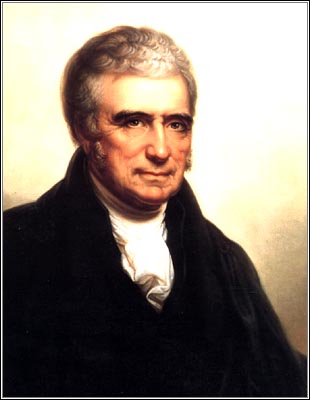
(1803) Marbury v. Madison
-William Marbury (one of Adams' midnight appointments), sued Secretary of State Madison to force delivery of his commission as a justice of the peace in the federal district; Marshall would not rule on it, because he said the law that gave the Supreme Court power to rule over such matter was unconstitutional
-established the policy of judicial review over federal legislation
-Precedent of the Supreme Court's power to rule on the constitutionality of federal laws
(1810) Fletcher v. Peck
-Georgia legislature issued extensive land grants to Yazoo Land Company; afterwards, it was considered corrupt, so there was a legislative session that repealed the action
-Court ruled that the original contract was valid and could not be broken
(1819) Dartmouth College v. Woodward
-Republicans back the president of the college, Federalists backed the trustees
-president try to make it a public institution (instead of private) by having the charter revoked
-ruled that even though charter was granted by the king, it was still a contract and thus could not be changed without the consent of both parties
(1819) McCulloch v. Maryland
-state of MD tried to levy a tax on the Baltimore branch of the Bank of the United States (to protect the competitive position of state banks)
-ruled against state, b/c state had no right to control an agency of the federal gov't
(1824) Gibbons v. Ogden
-NY state had granted monopoly to Ogden of Hudson River. Gibbons obtained a permit from Congress to operate steamboat there
-Ogden sued, and state ruled in his favor
-Marshall ruled that it was interstate commerce and could not be regulated by a state (only Congress could) - the monopoly was then voided
(1831) Cherokee Nation v. Georgia
-Court refused to hear case, which the Cherokees brought forward, b/c GA had abolished their tribal legislature and courts (said that because the tribe was a "foreign nation, the decision should be made by the Supreme Court)
-Marshall said they really were not foreign nations (they just had special status)
(1832) Worcester v.Georgia
-GA state gov't said any US citizen who wanted to enter Cherokee territory had to obtain permission from the governor
-GA law was overturned, b/c the federal gov't had the constitutionally mandated role of regulating trade with the tribes
-Jackson said of Marshall "John Marshall has made his decision. Now let him enforce it"
Era of Good Feelings?
Era of Good Feelings? Consider the years, 1815-1825 (Monroe) as well as nationalism and sectionalism
Sectionalism (rainy day)
Tariff of 1816- higher and first protective tax to aid industries in the North, hurt southerners
Tallmadge Amendment-defeated bill called for gradual emancipation of slavery in Missouri, began slavery debate
Missouri Compromise- growing problems with the expansion of slavery in territories, slavery will eventually divide the nation
Slave Revolts- Denmark Vessey, called for local action to invoke stronger slave codes in the South
Election of 1820 & 1824
1820- one-party system following death of Federalist Party (Hartford Convention in 1816)
1824- Electoral vote divided between 4 regional candidates with Quincy Adams winning after the “corrupt bargain” with Henry Clay, rise of Whig Party
Political and sectional differences became more intense
Calhoun moves from nationalist to states’ rights supporter
Panic of 1819
Each section hurt by depression but more severe in the West due to the tightening of credit by the Second Bank of the US, South and West (advocated easy credit) blamed Bank and the eastern establishment for the Panic
Westward Movement (beginnings of Manifest Destiny)
With migration westward, inevitable clash between the rural areas of the South and West with the urban areas of the East as well as slavery in the newly acquired territories
King Cotton
Eli Whitney’s cotton gin and cheap, available lands in the West makes the South more dependent on slave labor, growth of the factory system and corporations as well as interchangeable parts in the Northeast (Slater, Lowell system, textile mills, unions)
Immigration
Old Immigrants (Irish and Germans) move to the NE and Midwest
American Colonization Society-move slaves back to Africa
Nationalism (sunny day)
War of 1812
US gained respect for other nations after surviving two wars with Britain
Became more economically self-sufficient
Evokes feelings of patriotism, national celebrations and use of the flag
US entering era of unlimited prosperity
Monroe Doctrine
Strong interventionist foreign policy again Britain who sought to recolonize the Central and South America
Literature
James Fenimore Cooper & Washington Irving (American writers/American themes)
Artists
Patriotic themes in painting of Gilbert Stuart, Charles Wilson Peale, John Trumball and school books (Webster’s dictionary)
Clay’s American System (cooperation of Federalist program by Democrats)
1. protective tariffs (helps East)
2. national bank (aid to all sections)
3. internal improvements (helps South & West), vetoed due to constitutional concerns
Marshall’s Supreme Court
Gave more power to the national government from the states as well as the Supreme Court (Marbury v. Madison)
McCulloch v. Maryland, Fletcher v. Peck, Gibbons v. Ogden, Dartmouth College v. Woodward
Transportation
Turnpikes, canals (linked east & west), steamships, railroads
Link nation and facilitate movement of goods and people
Led to Market Revolution and National Economy
One-Party System
Monroe wins all but one electoral vote in Election of 1820
Florida
Adams-Onis Treaty of 1819 cedes Florida to the US from Spain
Barbary Pirates-finally defeated, created euphoria
Sectionalism (rainy day)
Tariff of 1816- higher and first protective tax to aid industries in the North, hurt southerners
Tallmadge Amendment-defeated bill called for gradual emancipation of slavery in Missouri, began slavery debate
Missouri Compromise- growing problems with the expansion of slavery in territories, slavery will eventually divide the nation
Slave Revolts- Denmark Vessey, called for local action to invoke stronger slave codes in the South
Election of 1820 & 1824
1820- one-party system following death of Federalist Party (Hartford Convention in 1816)
1824- Electoral vote divided between 4 regional candidates with Quincy Adams winning after the “corrupt bargain” with Henry Clay, rise of Whig Party
Political and sectional differences became more intense
Calhoun moves from nationalist to states’ rights supporter
Panic of 1819
Each section hurt by depression but more severe in the West due to the tightening of credit by the Second Bank of the US, South and West (advocated easy credit) blamed Bank and the eastern establishment for the Panic
Westward Movement (beginnings of Manifest Destiny)
With migration westward, inevitable clash between the rural areas of the South and West with the urban areas of the East as well as slavery in the newly acquired territories
King Cotton
Eli Whitney’s cotton gin and cheap, available lands in the West makes the South more dependent on slave labor, growth of the factory system and corporations as well as interchangeable parts in the Northeast (Slater, Lowell system, textile mills, unions)
Immigration
Old Immigrants (Irish and Germans) move to the NE and Midwest
American Colonization Society-move slaves back to Africa
Nationalism (sunny day)
War of 1812
US gained respect for other nations after surviving two wars with Britain
Became more economically self-sufficient
Evokes feelings of patriotism, national celebrations and use of the flag
US entering era of unlimited prosperity
Monroe Doctrine
Strong interventionist foreign policy again Britain who sought to recolonize the Central and South America
Literature
James Fenimore Cooper & Washington Irving (American writers/American themes)
Artists
Patriotic themes in painting of Gilbert Stuart, Charles Wilson Peale, John Trumball and school books (Webster’s dictionary)
Clay’s American System (cooperation of Federalist program by Democrats)
1. protective tariffs (helps East)
2. national bank (aid to all sections)
3. internal improvements (helps South & West), vetoed due to constitutional concerns
Marshall’s Supreme Court
Gave more power to the national government from the states as well as the Supreme Court (Marbury v. Madison)
McCulloch v. Maryland, Fletcher v. Peck, Gibbons v. Ogden, Dartmouth College v. Woodward
Transportation
Turnpikes, canals (linked east & west), steamships, railroads
Link nation and facilitate movement of goods and people
Led to Market Revolution and National Economy
One-Party System
Monroe wins all but one electoral vote in Election of 1820
Florida
Adams-Onis Treaty of 1819 cedes Florida to the US from Spain
Barbary Pirates-finally defeated, created euphoria
Tuesday, September 28, 2010
This Date in History-Sept. 28
Sep 28, 1781:
Battle of Yorktown begins
On this day in 1781, General George Washington, commanding a force of 17,000 French and Continental troops, begins the siege known as the Battle of Yorktown against British General Lord Charles Cornwallis and a contingent of 9,000 British troops at Yorktown, Virginia, in the most important battle of the Revolutionary War.
Earlier, in a stroke of luck for the Patriots, the French fleet commanded by Francois, Count de Grasse, departed St. Domingue (the then-French colony that is now Haiti) for the Chesapeake Bay, just as Cornwallis chose Yorktown, at the mouth of the Chesapeake, as his base. Washington realized that it was time to act. He ordered Marquis de Lafayette and an American army of 5,000 troops to block Cornwallis' escape from Yorktown by land while the French naval fleet blocked the British escape by sea. By September 28, Washington had completely encircled Cornwallis and Yorktown with the combined forces of Continental and French troops. After three weeks of non-stop bombardment, both day and night, from cannon and artillery, Cornwallis surrendered to Washington in the field at Yorktown on October 17, 1781, effectively ending the War for Independence.
Pleading illness, Cornwallis did not attend the formal surrender ceremony, held on October 19. Instead, his second in command, General Charles O'Hara, carried Cornwallis' sword to the American and French commanders.
Although the war persisted on the high seas and in other theaters, the Patriot victory at Yorktown ended fighting in the American colonies. Peace negotiations began in 1782, and on September 3, 1783, the Treaty of Paris was signed, formally recognizing the United States as a free and independent nation after eight years of war.
Battle of Yorktown begins
On this day in 1781, General George Washington, commanding a force of 17,000 French and Continental troops, begins the siege known as the Battle of Yorktown against British General Lord Charles Cornwallis and a contingent of 9,000 British troops at Yorktown, Virginia, in the most important battle of the Revolutionary War.
Earlier, in a stroke of luck for the Patriots, the French fleet commanded by Francois, Count de Grasse, departed St. Domingue (the then-French colony that is now Haiti) for the Chesapeake Bay, just as Cornwallis chose Yorktown, at the mouth of the Chesapeake, as his base. Washington realized that it was time to act. He ordered Marquis de Lafayette and an American army of 5,000 troops to block Cornwallis' escape from Yorktown by land while the French naval fleet blocked the British escape by sea. By September 28, Washington had completely encircled Cornwallis and Yorktown with the combined forces of Continental and French troops. After three weeks of non-stop bombardment, both day and night, from cannon and artillery, Cornwallis surrendered to Washington in the field at Yorktown on October 17, 1781, effectively ending the War for Independence.
Pleading illness, Cornwallis did not attend the formal surrender ceremony, held on October 19. Instead, his second in command, General Charles O'Hara, carried Cornwallis' sword to the American and French commanders.
Although the war persisted on the high seas and in other theaters, the Patriot victory at Yorktown ended fighting in the American colonies. Peace negotiations began in 1782, and on September 3, 1783, the Treaty of Paris was signed, formally recognizing the United States as a free and independent nation after eight years of war.
Monday, September 27, 2010
This Date in History-Sept. 27
September 27: General Interest
1779 : John Adams appointed to negotiate peace terms with British
On this day in 1779, the Continental Congress appoints John Adams to travel to France as minister plenipotentiary in charge of negotiating treaties of peace and commerce with Great Britain during the Revolutionary War.
Adams had traveled to Paris in 1778 to negotiate an alliance with France, but had been unceremoniously dismissed when Congress chose Benjamin Franklin as sole commissioner. Soon after returning to Massachusetts in mid-1779, Adams was elected as a delegate to the state convention to draw up a new constitution; he was involved in these duties when he learned of his new diplomatic commission. Accompanied by his young sons John Quincy and Charles, Adams sailed for Europe that November aboard the French ship Sensible, which sprang a leak early in the voyage and missed its original destination (Brest), instead landing at El Ferrol, in northwestern Spain. After an arduous journey by mule train across the Pyrenees and into France, Adams and his group reached Paris in early February 1780.
While in Paris, Adams wrote to Congress almost daily (sometimes several letters a day) sharing news about British politics, British and French naval activities and his general perspective on European affairs. Conditions were unfavorable for peace at the time, as the war was going badly for the Continental Army, and the blunt and sometimes confrontational Adams clashed with the French government, especially the powerful Foreign Minister Charles Gravier, Comte de Vergennes. In mid-June, Adams began a correspondence with Vergennes in which he pushed for French naval assistance, antagonizing both Vergennes and Franklin, who brought the matter to the attention of Congress.
By that time, Adams had departed France for Holland, where he was attempting to negotiate a loan from the Dutch. Before the end of the year, he was named American minister to the Netherlands, replacing Henry Laurens, who was captured at sea by the British. In June 1781, capitulating to pressure from Vergennes and other French diplomats, Congress acted to revoke Adams' sole powers as peacemaker with Britain, appointing Franklin, Thomas Jefferson, John Jay and Laurens to negotiate alongside him.
The tide of the war was turning in America's favor, and Adams returned to Paris in October 1782 to take up his part in the peace negotiations. As Jefferson didn't travel to Europe and Laurens was in failing health after his release from the Tower of London, it was left to Adams, Jay and Franklin to represent American interests. Adams and Jay both distrusted the French government (in contrast with Franklin), but their differences of opinion and diplomatic styles allowed the team to negotiate favorable terms in the Peace of Paris (1783). The following year, Jefferson arrived to take Adams' place as American minister to France, forming a lifelong bond with Adams and his family before the latter left to take up his new post as American ambassador to London and continue his distinguished record of foreign service on behalf of the new nation.
1779 : John Adams appointed to negotiate peace terms with British
On this day in 1779, the Continental Congress appoints John Adams to travel to France as minister plenipotentiary in charge of negotiating treaties of peace and commerce with Great Britain during the Revolutionary War.
Adams had traveled to Paris in 1778 to negotiate an alliance with France, but had been unceremoniously dismissed when Congress chose Benjamin Franklin as sole commissioner. Soon after returning to Massachusetts in mid-1779, Adams was elected as a delegate to the state convention to draw up a new constitution; he was involved in these duties when he learned of his new diplomatic commission. Accompanied by his young sons John Quincy and Charles, Adams sailed for Europe that November aboard the French ship Sensible, which sprang a leak early in the voyage and missed its original destination (Brest), instead landing at El Ferrol, in northwestern Spain. After an arduous journey by mule train across the Pyrenees and into France, Adams and his group reached Paris in early February 1780.
While in Paris, Adams wrote to Congress almost daily (sometimes several letters a day) sharing news about British politics, British and French naval activities and his general perspective on European affairs. Conditions were unfavorable for peace at the time, as the war was going badly for the Continental Army, and the blunt and sometimes confrontational Adams clashed with the French government, especially the powerful Foreign Minister Charles Gravier, Comte de Vergennes. In mid-June, Adams began a correspondence with Vergennes in which he pushed for French naval assistance, antagonizing both Vergennes and Franklin, who brought the matter to the attention of Congress.
By that time, Adams had departed France for Holland, where he was attempting to negotiate a loan from the Dutch. Before the end of the year, he was named American minister to the Netherlands, replacing Henry Laurens, who was captured at sea by the British. In June 1781, capitulating to pressure from Vergennes and other French diplomats, Congress acted to revoke Adams' sole powers as peacemaker with Britain, appointing Franklin, Thomas Jefferson, John Jay and Laurens to negotiate alongside him.
The tide of the war was turning in America's favor, and Adams returned to Paris in October 1782 to take up his part in the peace negotiations. As Jefferson didn't travel to Europe and Laurens was in failing health after his release from the Tower of London, it was left to Adams, Jay and Franklin to represent American interests. Adams and Jay both distrusted the French government (in contrast with Franklin), but their differences of opinion and diplomatic styles allowed the team to negotiate favorable terms in the Peace of Paris (1783). The following year, Jefferson arrived to take Adams' place as American minister to France, forming a lifelong bond with Adams and his family before the latter left to take up his new post as American ambassador to London and continue his distinguished record of foreign service on behalf of the new nation.


Sunday, September 26, 2010
This Date in History-Sept. 26
September 26: General Interest
1960 : First Kennedy-Nixon debate
For the first time in U.S. history, a debate between major party presidential candidates is shown on television. The presidential hopefuls, John F. Kennedy, a Democratic senator of Massachusetts, and Richard M. Nixon, the vice president of the United States, met in a Chicago studio to discuss U.S. domestic matters.
Kennedy emerged the apparent winner from this first of four televised debates, partly owing to his greater ease before the camera than Nixon, who, unlike Kennedy, seemed nervous and declined to wear makeup. Nixon fared better in the second and third debates, and on October 21 the candidates met to discuss foreign affairs in their fourth and final debate. Less than three weeks later, on November 8, Kennedy won 49.7 percent of the popular vote in one of the closest presidential elections in U.S. history, surpassing by a fraction the 49.6 percent received by his Republican opponent.
One year after leaving the vice presidency, Nixon returned to politics, winning the Republican nomination for governor of California. Although he lost the election, Nixon returned to the national stage in 1968 in a successful bid for the presidency. Like Lyndon Johnson in 1964, Nixon declined to debate his opponent in the 1968 presidential campaign. Televised presidential debates returned in 1976, and have been held in every presidential campaign since.
1960 : First Kennedy-Nixon debate
For the first time in U.S. history, a debate between major party presidential candidates is shown on television. The presidential hopefuls, John F. Kennedy, a Democratic senator of Massachusetts, and Richard M. Nixon, the vice president of the United States, met in a Chicago studio to discuss U.S. domestic matters.
Kennedy emerged the apparent winner from this first of four televised debates, partly owing to his greater ease before the camera than Nixon, who, unlike Kennedy, seemed nervous and declined to wear makeup. Nixon fared better in the second and third debates, and on October 21 the candidates met to discuss foreign affairs in their fourth and final debate. Less than three weeks later, on November 8, Kennedy won 49.7 percent of the popular vote in one of the closest presidential elections in U.S. history, surpassing by a fraction the 49.6 percent received by his Republican opponent.
One year after leaving the vice presidency, Nixon returned to politics, winning the Republican nomination for governor of California. Although he lost the election, Nixon returned to the national stage in 1968 in a successful bid for the presidency. Like Lyndon Johnson in 1964, Nixon declined to debate his opponent in the 1968 presidential campaign. Televised presidential debates returned in 1976, and have been held in every presidential campaign since.
This Date in History-Sept. 25
September 25: General Interest
1957 : Central High School integrated
Under escort from the U.S. Army's 101st Airborne Division, nine black students enter all-white Central High School in Little Rock, Arkansas. Three weeks earlier, Arkansas Governor Orval Faubus had surrounded the school with National Guard troops to prevent its federal court-ordered racial integration. After a tense standoff, President Dwight D. Eisenhower federalized the Arkansas National Guard and sent 1,000 army paratroopers to Little Rock to enforce the court order.
On May 17, 1954, the U.S. Supreme Court ruled unanimously in Brown v. Board of Education of Topeka that racial segregation in educational facilities was unconstitutional. Five days later, the Little Rock School Board issued a statement saying it would comply with the decision when the Supreme Court outlined the method and time frame in which desegregation should be implemented.
Arkansas was at the time among the more progressive Southern states in regard to racial issues. The University of Arkansas School of Law was integrated in 1949, and the Little Rock Public Library in 1951. Even before the Supreme Court ordered integration to proceed "with all deliberate speed," the Little Rock School Board in 1955 unanimously adopted a plan of integration to begin in 1957 at the high school level. The National Association for the Advancement of Colored People (NAACP) filed suit, arguing the plan was too gradual, but a federal judge dismissed the suit, saying that the school board was acting in "utmost good faith." Meanwhile, Little Rock's public buses were desegregated. By 1957, seven out of Arkansas' eight state universities were integrated.
In the spring of 1957, there were 517 black students who lived in the Central High School district. Eighty expressed an interest in attending Central in the fall, and they were interviewed by the Little Rock School Board, which narrowed down the number of candidates to 17. Eight of those students later decided to remain at all-black Horace Mann High School, leaving the "Little Rock Nine" to forge their way into Little Rock's premier high school.
In August 1957, the newly formed Mother's League of Central High School won a temporary injunction from the county chancellor to block integration of the school, charging that it "could lead to violence." Federal District Judge Ronald Davies nullified the injunction on August 30. On September 2, Governor Orval Faubus--a staunch segregationist--called out the Arkansas National Guard to surround Central High School and prevent integration, ostensibly to prevent the bloodshed he claimed desegregation would cause. The next day, Judge Davies ordered integrated classes to begin on September 4.
That morning, 100 armed National Guard troops encircled Central High School. A mob of 400 white civilians gathered and turned ugly when the black students began to arrive, shouting racial epithets and threatening the teenagers with violence. The National Guard troops refused to let the black students pass and used their clubs to control the crowd. One of the nine, 15-year-old Elizabeth Eckford, was surrounded by the mob, which threatened to lynch her. She was finally led to safety by a sympathetic white woman.
Little Rock Mayor Woodrow Mann condemned Faubus' decision to call out the National Guard, but the governor defended his action, reiterating that he did so to prevent violence. The governor also stated that integration would occur in Little Rock when and if a majority of people chose to support it. Faubus' defiance of Judge Davies' court order was the first major test of Brown v. Board of Education and the biggest challenge of the federal government's authority over the states since the Reconstruction Era.
The standoff continued, and on September 20 Judge Davies ruled that Faubus had used the troops to prevent integration, not to preserve law and order as he claimed. Faubus had no choice but to withdraw the National Guard troops. Authority over the explosive situation was put in the hands of the Little Rock Police Department.
On September 23, as a mob of 1,000 whites milled around outside Central High School, the nine black students managed to gain access to a side door. However, the mob became unruly when it learned the black students were inside, and the police evacuated them out of fear for their safety. That evening, President Eisenhower issued a special proclamation calling for opponents of the federal court order to "cease and desist." On September 24, Little Rock's mayor sent a telegram to the president asking him to send troops to maintain order and complete the integration process. Eisenhower immediately federalized the Arkansas National Guard and approved the deployment of U.S. troops to Little Rock. That evening, from the White House, the president delivered a nationally televised address in which he explained that he had taken the action to defend the rule of law and prevent "mob rule" and "anarchy." On September 25, the Little Rock Nine entered the school under heavily armed guard.
Troops remained at Central High School throughout the school year, but still the black students were subjected to verbal and physical assaults from a faction of white students. Melba Patillo, one of the nine, had acid thrown in her eyes, and Elizabeth Eckford was pushed down a flight of stairs. The three male students in the group were subjected to more conventional beatings. Minnijean Brown was suspended after dumping a bowl of chili over the head of a taunting white student. She was later suspended for the rest of the year after continuing to fight back. The other eight students consistently turned the other cheek. On May 27, 1958, Ernest Green, the only senior in the group, became the first black to graduate from Central High School.
Governor Faubus continued to fight the school board's integration plan, and in September 1958 he ordered Little Rock's three high schools closed rather than permit integration. Many Little Rock students lost a year of education as the legal fight over desegregation continued. In 1959, a federal court struck down Faubus' school-closing law, and in August 1959 Little Rock's white high schools opened a month early with black students in attendance. All grades in Little Rock public schools were finally integrated in 1972.
1957 : Central High School integrated
Under escort from the U.S. Army's 101st Airborne Division, nine black students enter all-white Central High School in Little Rock, Arkansas. Three weeks earlier, Arkansas Governor Orval Faubus had surrounded the school with National Guard troops to prevent its federal court-ordered racial integration. After a tense standoff, President Dwight D. Eisenhower federalized the Arkansas National Guard and sent 1,000 army paratroopers to Little Rock to enforce the court order.
On May 17, 1954, the U.S. Supreme Court ruled unanimously in Brown v. Board of Education of Topeka that racial segregation in educational facilities was unconstitutional. Five days later, the Little Rock School Board issued a statement saying it would comply with the decision when the Supreme Court outlined the method and time frame in which desegregation should be implemented.
Arkansas was at the time among the more progressive Southern states in regard to racial issues. The University of Arkansas School of Law was integrated in 1949, and the Little Rock Public Library in 1951. Even before the Supreme Court ordered integration to proceed "with all deliberate speed," the Little Rock School Board in 1955 unanimously adopted a plan of integration to begin in 1957 at the high school level. The National Association for the Advancement of Colored People (NAACP) filed suit, arguing the plan was too gradual, but a federal judge dismissed the suit, saying that the school board was acting in "utmost good faith." Meanwhile, Little Rock's public buses were desegregated. By 1957, seven out of Arkansas' eight state universities were integrated.
In the spring of 1957, there were 517 black students who lived in the Central High School district. Eighty expressed an interest in attending Central in the fall, and they were interviewed by the Little Rock School Board, which narrowed down the number of candidates to 17. Eight of those students later decided to remain at all-black Horace Mann High School, leaving the "Little Rock Nine" to forge their way into Little Rock's premier high school.
In August 1957, the newly formed Mother's League of Central High School won a temporary injunction from the county chancellor to block integration of the school, charging that it "could lead to violence." Federal District Judge Ronald Davies nullified the injunction on August 30. On September 2, Governor Orval Faubus--a staunch segregationist--called out the Arkansas National Guard to surround Central High School and prevent integration, ostensibly to prevent the bloodshed he claimed desegregation would cause. The next day, Judge Davies ordered integrated classes to begin on September 4.
That morning, 100 armed National Guard troops encircled Central High School. A mob of 400 white civilians gathered and turned ugly when the black students began to arrive, shouting racial epithets and threatening the teenagers with violence. The National Guard troops refused to let the black students pass and used their clubs to control the crowd. One of the nine, 15-year-old Elizabeth Eckford, was surrounded by the mob, which threatened to lynch her. She was finally led to safety by a sympathetic white woman.
Little Rock Mayor Woodrow Mann condemned Faubus' decision to call out the National Guard, but the governor defended his action, reiterating that he did so to prevent violence. The governor also stated that integration would occur in Little Rock when and if a majority of people chose to support it. Faubus' defiance of Judge Davies' court order was the first major test of Brown v. Board of Education and the biggest challenge of the federal government's authority over the states since the Reconstruction Era.
The standoff continued, and on September 20 Judge Davies ruled that Faubus had used the troops to prevent integration, not to preserve law and order as he claimed. Faubus had no choice but to withdraw the National Guard troops. Authority over the explosive situation was put in the hands of the Little Rock Police Department.
On September 23, as a mob of 1,000 whites milled around outside Central High School, the nine black students managed to gain access to a side door. However, the mob became unruly when it learned the black students were inside, and the police evacuated them out of fear for their safety. That evening, President Eisenhower issued a special proclamation calling for opponents of the federal court order to "cease and desist." On September 24, Little Rock's mayor sent a telegram to the president asking him to send troops to maintain order and complete the integration process. Eisenhower immediately federalized the Arkansas National Guard and approved the deployment of U.S. troops to Little Rock. That evening, from the White House, the president delivered a nationally televised address in which he explained that he had taken the action to defend the rule of law and prevent "mob rule" and "anarchy." On September 25, the Little Rock Nine entered the school under heavily armed guard.
Troops remained at Central High School throughout the school year, but still the black students were subjected to verbal and physical assaults from a faction of white students. Melba Patillo, one of the nine, had acid thrown in her eyes, and Elizabeth Eckford was pushed down a flight of stairs. The three male students in the group were subjected to more conventional beatings. Minnijean Brown was suspended after dumping a bowl of chili over the head of a taunting white student. She was later suspended for the rest of the year after continuing to fight back. The other eight students consistently turned the other cheek. On May 27, 1958, Ernest Green, the only senior in the group, became the first black to graduate from Central High School.
Governor Faubus continued to fight the school board's integration plan, and in September 1958 he ordered Little Rock's three high schools closed rather than permit integration. Many Little Rock students lost a year of education as the legal fight over desegregation continued. In 1959, a federal court struck down Faubus' school-closing law, and in August 1959 Little Rock's white high schools opened a month early with black students in attendance. All grades in Little Rock public schools were finally integrated in 1972.
Subscribe to:
Posts (Atom)