Chapter 6: The New Republic
George Washington
Executive Depts.
Judiciary Act of 1789
Federal Census
Alexander Hamilton
Hamilton’s Economic Plan
National Debt
Assumption
Infant Industries
National Bank
Thomas Jefferson
Funding at Par
Speculators
State-Debt Compromise
Necessary and Proper (Elastic) Clause
Implied v. Enumerated Powers
Loose v. Strict Construction
French Revolution
Proclamation of Neutrality (1793)
“Citizen” Edmund Genet
Jay Treaty (1794)
Impressment
Pinckney Treaty (1795)
Right of Deposit
“Mad” Anthony Wayne
Treaty of Greenville
Whiskey Rebellion (1794)
Excise Tax
Public Land Act (1796)
Two-Party System
Federalist Era
Political Parties
Federalist v. Democratic-Republicans (see page 109)
Washington’s Farewell Address
Political Parties
Permanent Alliances
Two-term Tradition
Election of 1796
12th Amendment
John Adams
XYZ Affair
“Millions for defense, but not one cent for tribute”
Quasi-War
High Federalists
Alien & Seditions Acts
Naturalization Act
Alien Acts
Sedition Acts
KY & VA Resolutions
Compact Theory
Nullification
Navy Dept.
Election of 1800
Revolution of 1800

Tuesday, September 21, 2010

Washington/Adams & Federalists v. D-Rs (Very Important)
Washington, Hamilton, and shaping the federal government
-Executive Department (creation of a cabinet), Federal Court system (created by Judiciary Act of 1789), Hamilton Economic Plan (Assumption of the debt, protective tariffs, national bank, excise tax, Whiskey Rebellion (showed government’s ability to put down as uprising unlike Shays’ Rebellion), Proclamation of Neutrality (dealing with French Revolution and British/French War), Jay Treaty, Pinckney Treaty, Washington warns against entangling alliance and political parties in Farewell Address
Adams (XYZ Affair, Quasi-War with France, Alien and Sedition Acts (KY & VA Resolutions)
Emergence of Political Parties (started over the debate the Constitution and the role of the federal govt.)
Federalists: Hamilton, loose interpretation of the Constitution, Pro-British, Large peacetime army & navy, Aid businesses, national bank, tariffs, Northern businessmen and large landowners, Northeast
Democratic-Republicans: Jefferson & Madison, strict interpretation, weak central govt., Pro-French, Small peacetime army and navy, favored agricultural interests, no national bank, opposed tariffs (hurt the South and farmers), skilled workers, small farmers, plantation owners, later immigrants, strong in the South/West
Republican motherhood and education for women
Gained status from their Revolutionary War efforts, Abigail Adams (remember the ladies), women instilled with educating republican ideals into their children, women limited in education but southern women educated through private tutors and northern women education in public schools
-Executive Department (creation of a cabinet), Federal Court system (created by Judiciary Act of 1789), Hamilton Economic Plan (Assumption of the debt, protective tariffs, national bank, excise tax, Whiskey Rebellion (showed government’s ability to put down as uprising unlike Shays’ Rebellion), Proclamation of Neutrality (dealing with French Revolution and British/French War), Jay Treaty, Pinckney Treaty, Washington warns against entangling alliance and political parties in Farewell Address
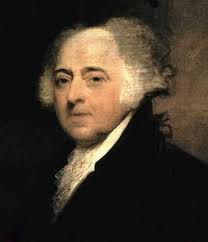 |
| John Adams |
Emergence of Political Parties (started over the debate the Constitution and the role of the federal govt.)
Federalists: Hamilton, loose interpretation of the Constitution, Pro-British, Large peacetime army & navy, Aid businesses, national bank, tariffs, Northern businessmen and large landowners, Northeast
Democratic-Republicans: Jefferson & Madison, strict interpretation, weak central govt., Pro-French, Small peacetime army and navy, favored agricultural interests, no national bank, opposed tariffs (hurt the South and farmers), skilled workers, small farmers, plantation owners, later immigrants, strong in the South/West
Republican motherhood and education for women
Gained status from their Revolutionary War efforts, Abigail Adams (remember the ladies), women instilled with educating republican ideals into their children, women limited in education but southern women educated through private tutors and northern women education in public schools
 |
| Washington Takes the Oath: NYC 1789 |
This Date in History-Sept. 21

1780 : Benedict Arnold commits treason
On this day in 1780, during the American Revolution, American General Benedict Arnold meets with British Major John Andre to discuss handing over West Point to the British, in return for the promise of a large sum of money and a high position in the British army. The plot was foiled and Arnold, a former American hero, became synonymous with the word "traitor."
Arnold was born into a well-respected family in Norwich, Connecticut, on January 14, 1741. He apprenticed with an apothecary and was a member of the militia during the French and Indian War (1754-1763). He later became a successful trader and joined the Continental Army when the Revolutionary War broke out between Great Britain and its 13 American colonies in 1775. When the war ended in 1883, the colonies had won their independence from Britain and formed a new nation, the United States.
During the war, Benedict Arnold proved himself a brave and skillful leader, helping Ethan Allen's troops capture Fort Ticonderoga in 1775 and then participating in the unsuccessful attack on British Quebec later that year, which earned him a promotion to brigadier general. Arnold distinguished himself in campaigns at Lake Champlain, Ridgefield and Saratoga, and gained the support of George Washington. However, Arnold had enemies within the military and in 1777, five men of lesser rank were promoted over him. Over the course of the next few years, Arnold married for a second time and he and his new wife lived a lavish lifestyle in Philadelphia, accumulating substantial debt. The debt and the resentment Arnold felt over not being promoted faster were motivating factors in his choice to become a turncoat.
In 1780, Arnold was given command of West Point, an American fort on the Hudson River in New York (and future home of the U.S. military academy, established in 1802). Arnold contacted Sir Henry Clinton, head of the British forces, and proposed handing over West Point and his men. On September 21 of that year, Arnold met with Major John Andre and made his traitorous pact. However, the conspiracy was uncovered and Andre was captured and executed. Arnold, the former American patriot, fled to the enemy side and went on to lead British troops in Virginia and Connecticut. He later moved to England, though he never received all of what he'd been promised by the British. He died in London on June 14, 1801.
Monday, September 20, 2010
James Madison: The Father of American Politics

James Madison is known as the Father of the Constitution, reflecting his role in planning, writing and ratifying the nation's fundamental law. This should be his month: The Constitutional Convention, where he starred, finished the document in September 1787. And Congress sent the amendments that became the Bill of Rights—which Madison also played a major role in shaping—to the states in September 1789.
But Madison has another claim on our attention. He is the father of American politics as we know it.
Madison helped establish America's first political party, the Republicans. In 1791, as a representative from Virginia, he joined Secretary of State Thomas Jefferson on a trip through upstate New York and New England, supposedly collecting biological specimens for the American Philosophical Society but actually collecting political allies for themselves. The politician they wished to combat, Treasury Secretary Alexander Hamilton, already wielded great power through his office, and hence he was somewhat slower to organize a party; when he did, it took the name Federalists.
James Madison, the fourth U.S. president
.Madison and Jefferson built better than Hamilton: the Federalists disappeared as a national party in 1816, while the old Republicans march on today as the Democrats. (The modern GOP is an unrelated organization established in 1854.)
Madison helped found the first party newspaper, the National Gazette. (The Nation, The New Republic and National Review are latter-day reincarnations.) He recruited the paper's first editor, Philip Freneau, a versifier and college chum. Jefferson gave Freneau a nominal job as a translator in the State Department and in his free time Freneau smacked Hamilton in prose.
Madison's interest in newspapers flowed from his interest in the power of public opinion. "Whatever facilitates a general intercourse of sentiments," he wrote in a December, 1791 National Gazette essay,
". . . a circulation of newspapers throughout the entire body of the people . . . is favorable to liberty." Then "every good citizen will be . . . a sentinel over the rights of the people."
Drowning in both media and poll data today, we understand the importance of regularly measuring public opinion. But in the early republic consulting public opinion was a new concept.
The Federalists had little use for it. They thought the people should rule at the polls, then let the victors do their best until the next election. Madison foresaw, and applauded, our world of 24/7 news, comment and pulse-taking before it existed.
Madison belonged to an early form of the political machine, the dynasty. America had revolted against George III and the House of Hanover, but the dynastic temptation lingered on. Federalist John Adams, our second president, saw his eldest son, John Quincy Adams, become the sixth president. But the Adamses were unpopular one-termers. Between them stretched the Virginia Dynasty—two terms of Jefferson, two terms of Madison, two terms of James Monroe—24 years of government by friends and neighbors.
The Adamses—and the Kennedys, Bushes and Clintons in our day—had dynasties of blood and marriage. Jefferson, Madison and Monroe made a dynasty of ideological brotherhood.
Not that Madison ignored the political importance of marriage. After an unhappy courtship in his early 30s, he left romance alone until he was 43, when he married a pretty widow, Dolley Payne Todd. When Madison took office as Secretary of State (in 1801) and as president in 1809, Dolley Madison became more than a hostess. She was a political wife, America's first: half a campaign tag-team, and often the better half. Gregarious and outgoing, she completed her husband's personality, which was shy and stiff except with intimates.
Martha Washington, the first First Lady, was beloved but domestic; Abigail Adams, the second, was political but abrasive. Thomas Jefferson, the third president, was a widower. As one U.S. senator put it, only Madison had "a wife to aid in his pretensions."
Madison succeeded as a political innovator because he was good at politics. He did what came naturally to him: agenda-setting, committee work, parliamentary maneuvering. He grew up in a family as large as an oyster bed—six siblings who survived childhood, numerous nieces, nephews and cousins—good training for a future legislator.
He worked at what didn't come naturally: public speaking and campaigning. His voice was weak; time and again, note-takers at debates he participated in (such as in Virginia's convention to ratify the U.S. Constitution) left blanks in his remarks or simply gave up, because Mr. Madison "could not be distinctly heard." Yet when circumstances required it, he took on the flamboyant Patrick Henry and once tangled with his friend Monroe in the open air of a snow storm so bitter he got frost bite on his nose. He won both debates.
Madison played well with others. He worked with George Washington, profiting from his charisma and judgment, and before they fell out with Hamilton, profiting from his exuberance. (Hamilton tapped Madison to contribute to the Federalist Papers, which was initially Hamilton's project; Madison wrote 29 of the 85 essays.) As president, he learned something about money and the world from his Treasury secretary, Albert Gallatin. He was a great man who was not afraid of assisting or deferring to other great men (another legacy of his tight family life). He also worked with the less-than-great: hatchetmen, gossips, wire-pullers. They do the work of politics too. They are part of the game.
James Madison helped build a republic. He was also an ambitious party activist who counted votes, stumped, spoke, scratched backs and (when necessary) stabbed them. He would not be afraid of the contrast, for his deepest thinking told him that the architects of liberty had to understand and sometimes use the ordinary political materials of ambition and self-advancement to ensure that this republic would endure.
Mr. Brookhiser is the author, most recently, of "Right Time, Right Place: Coming of Age with William F. Buckley Jr. and the Conservative Movement" (Basic Books, 2009).
Saturday, September 18, 2010
Friday, September 17, 2010


Citizenship Test
http://www.800citizen.org/us_citizenship_test/
In honor of Constitution Day, take the 50 question quiz. Please post your results. Were there questions that surprised you or found particularly difficult?
In honor of Constitution Day, take the 50 question quiz. Please post your results. Were there questions that surprised you or found particularly difficult?
Monday, September 13, 2010
Subscribe to:
Posts (Atom)